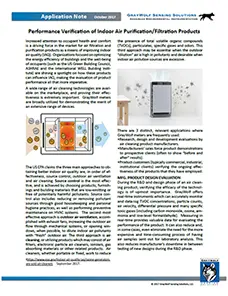
Increased attention to occupant health and comfort is a driving force in the market for air filtration and purification products as a means of improving indoor air quality (IAQ). Organizations focused on optimizing the energy efficiency of buildings and the well-being of occupants (such as the US Green Building Council, ASHRAE and the International WELL Building Institute) are shining a spotlight on how these products can influence IAQ, making the evaluation of product performance all that more imperative.
The US EPA claims the three main approaches to obtaining better indoor air quality are, in order of ef-fectiveness, source control, outdoor air ventilation and air cleaning. Source control is the most effective, and is achieved by choosing products, furnishings and building materials that are low-emitting or free of potentially harmful pollutants. Source control also includes reducing or removing pollutant sources through good housekeeping and personal hygiene practices, as well as performing preventive maintenance on HVAC systems. The second most effective approach is outdoor air ventilation, accomplished with exhaust fans, increasing the outdoor air flow through mechanical systems, or opening windows, when possible, to dilute indoor air pollutants with “fresh” outdoor air. The third approach is air cleaning, or utilizing products which may consist of air filters, electronic particle air cleaners, ionizers, gas absorbing materials or other related products. Air cleaners, whether portable or fixed, work to reduce the presence of total volatile organic compounds (TVOCs), particulates, specific gases and odors. This third approach may be essential when the outdoor “dilution” air is high in pollutants and desirable when indoor air pollution sources are excessive.
There are 3 distinct, relevant applications where GrayWolf meters are frequently used:
A variety of air cleaning product manufacturers and end users utilize GrayWolf meters. One example is companies that manufacture sprays which, when combined with light, eliminate irritating airborne particulates, including many VOCs. After a prescribed amount of time a second application of the spray is required. Determining when the next application is necessary can be identified with the GrayWolf equipment by the end customer or the company applying the spray. These companies implement their technologies in hospitality, facility management, auto and transport, healthcare, and agriculture markets.
GrayWolf meters are also used by companies with technology that ionizes the air by creating positive and negative ions that lead to particle reduction. The ionization causes the airborne particles to stick together through ionic bonding and results in lower concentrations of particulates and VOCs. Such units are used in arenas, schools, casinos, retail, airports, residential, and hospitals.
There are other companies that implement GrayWolf meters for testing units with an ultraviolet light to disinfect and purify air. These units have applications for museums, clean rooms, food processing, and pharmaceutical facilities where particulate, TVOCs, and low-level formaldehyde are of special interest.
Another specific application is manufacturing products that target air pollutants that negatively impact human embryonic development. By combining activated carbon filters to remove VOCs and aldehydes, with HEPA filters to remove particulate matter, units can be used in in-vitro fertilization (IVF) labs, hospitals, stem cell laboratories, schools, and for newborns to improve the air quality. In extremely sensitive envi-ronments, being able to continuously monitor TVOCs, formaldehyde, and particulates is not only important at the time of sale, but throughout the unit’s lifetime.
There is an added benefit of using the GrayWolf equipment for measuring the humidity and CO, in IVF cham-bers. GrayWolf also offers photo ionization detectors (PIDs) specifically designed for higher humidity environments when measuring TVOCs in this application.
Having GrayWolf meters available at any or all three stages; R&D, sales demonstrations, and customers’ product performance verification over time ultimately saves time, money, and leads to better air quality.